LECTURE VIII DEALING
WITH PARAGRAPHS
2. OLD AND NEW INFORMATION
3. THE ORDERING OF
SENTENCES IN A PARAGRAPH
1. COHERENCE
COHERENCE means «reasonable connection» — «an orderly
relationship between parts». It's the quality that makes
the difference between a set of UNconnected
phrases or clauses, on the one hand, and a simple, compound or complex
sentence, on the other hand (see Unit 2 of the Appendix [Section V of Part II]
on Compound and Complex Sentence Patterns). It also makes the difference
between a set of UNconnected
sentences and a PARAGRAPH (which is a set of CONNECTED sentences). Finally, the
same quality — COHERENCE — makes the difference between a set of UNconnected
paragraphs and a TEXT.
The writer makes his sentences, paragraphs and text
coherent by using various cues and signals that establish the «orderly
relationship» between the various parts of his sentences, between the various
sentences in his paragraphs, and between the various paragraphs in his text. It
is the job of the reader to follow these cues and signals and understand the
relationships.
CUES AND SIGNALS USED TO ESTABLISH
COHERENCE
1. Grammatical Signals such as conjunctions (Section V
of Part II Unit 4; the position of a given word in the sentence (Section V,
Unit 2); and grammatically meaningful word endings (Word Power [Part I]
Section X, Unit IE).
2.
Punctuation Signals (Section V of Part II, Unit 3).
3.
Visual Cues such as paragraph indentation.
4.
Verbal Cues such as repeated words (to emphasize connections).
5.
Pronouns (to refer backwards and forwards instead of simply repeating words).
6.
Various Other Verbal Cues (Section V of part II, Unit 6).
A. Which of these two «sentences» makes some kind of
sense (and why)? (How can a sentence make «sense» without being logical?)
a. Sleep green colorless furiously ideas.
b. Colorless green ideas sleep furiously.
B. The sentences that make up a coherent paragraph must be grammatically and logically connected. What makes
the «paragraph» below incoherent?
People love music. There are carbon granules in the
telephone receiver. Although the Japanese people are remarkable. Her dog was killed. In the southern part of Jordan
there is a place of unique historical interest.
C. Now consider the paragraph below:
Cecil, the aardvark, was a strange pet. Because of his
exotic eating habits, he was able to rid the house of insects. What he devoured
most often were the little dark ants. He was often seen
routing these out with his long ugly snout. Granted, his snout made him an
excellent exterminator. However, it also made him an unusual household pet.
List the features that make this a coherent paragraph.
D.
Below is another example of a COHERENT parapraph. The
various devices used by the writer to establish coherence have been clearly
marked, and they include the following:
1. Pronouns. The «we» in sentence 5 hooks back not
only to «higher animals» but to the readers
themselves, referred to in the first sentence with «our».
2. Summary nouns and pronouns. The «this» in sentence
6 pulls together the entire paragraph by referring to «experiment» and «play»
in sentence 5 and to the «process of learning» in sentence 1. Sometimes a
summary noun will do this job. For example, sentence 6 might have read:
«Perhaps the nature of trial run is what gives. .»
3. Repeated words. «Scientist», «learning», and
«errors» reappear.
4. Repeated stems. Bronowski
used «an experiment» (the noun) followed by «experiments» (the verb).
5. Rewording of the same idea. A «harmless trial run» is later redefined as a «setting in which errors are not
fatal».
6. Punctuation. Colons usually tell us that an
explanation, an example or a list follows. Semicolons connect two main clauses
that generally are closely related.
7. Parallel construction. The grammatically parallel
construction of «the scientist experiments and the cub plays» (sentence 5)
emphasizes the parallel connection Bronowski wishes
to make.
Cues and Signals Used to Establish
Coherence
D: A passage with many
word and phrase cues
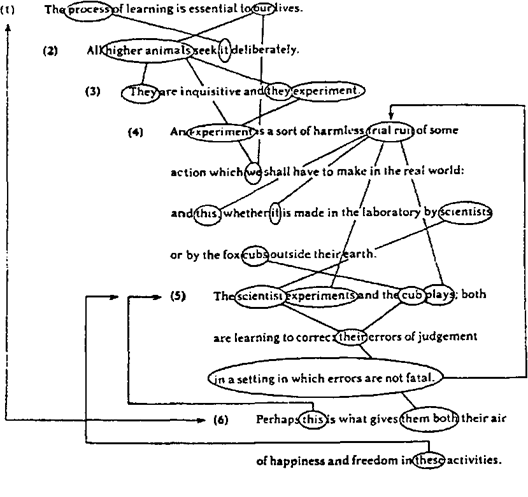 Source: Jacob Bronowski.
The Common Sense of Science (Cambridge: Harvard University Press, 1953).
Source: Jacob Bronowski.
The Common Sense of Science (Cambridge: Harvard University Press, 1953).
3.1 In he following
paragraph the cues and signals that establish coherence have been underlined. Study
each one and decide what type of coherence device it is. (Refer to the
list of devices preceding the Bronowski text
above).
Rescue dogs are often specially trained to work in
areas where a bomb or earthquake has buried
people in debris. Their job is to locate where the persons are buried so that rescuers can dig them out before
they suffocate or die of other injuries. Since the dog must guide
rescuers to the spot, he must be willing to sit and bark until
help comes. As a result some dogs, including
collies, shepherds, airedales, and, in
fact, most working breeds, can be trained for rescue; others
can't. Spaniels, setters, and some hounds, for example, refuse to bark once
they have found their person. Although they would bark at
home if someome
came to the door, these hunting breeds have been selectively bred not to
bark while working because it would scare the game.
3.2 Reorder the sentences below so that they form a
coherent paragraph.*
__
a. But because many new
summer workers don't know how to move large trees, the best ways to handle the
equipment, handle the trucks, or the large plants, their job is much harder.
__
b. Yet Timmerman does little to help summer employees
in these areas.
__
c. Or at least it shouldn't
be.
__
d. Timmerman Landscape Co. Inc. is a local nursery
that has recently moved into doing landscaping.
__
e. There is a waiting list for these jobs because the
pay is good and the work is outdoors but not as heavy as construction work.
__
f. They have a year-round staff of around ten people,
but in the summer they hire a lot of summer help to
meet peak summer workloads.
__
g. Most of the summer help are college students.
* (Key: a-6; b-7; c-5; d-1; e-4; f-2; g-3)
2. What features of each sentence help you determine
its position in the paragraph?
2. OLD AND
NEW INFORMATION
(Another Coherence Device)
In a paragraph, the writer usually establishes
coherence between sentences by referring back, in the first part of each
sentence, to what the reader already knows (Old Information) and by adding the
(New ) information that leads his argument forward in
the second part of each sentence.
Notice
how this pattern of Old Information leading to New Information works in the
following:
Shopping for a Turkey
|
|
Old ... New . . . |
|
|
The old information was stated in the title. |
In buying a turkey, you get more meat your money
from a whole bird than from a boned, rolled turkey roast. |
|
|
The reference to "the whole bird" is old
information from the preceding sentence. |
Old ... New . . . And the bigger that whole bird is, the more meat you will have in proportion to bone. |
|
|
Old ... New . . . A turkey weighing less than 12 pounds is one-half waste. |
||
|
The reference to a turkey's weight is old information, but the fact of |
||
|
one-half waste is new. |
|
|
|
«As a result» is old information, reffering to the points made previously in the
paragraph. |
Old ... New . . . As a result, it is more economical to buy half of a lage,
20 pounder than to buy a small, 10-pound turkey. |
At times this pattern of
moving from old information to new information is broken. For example:
Old ... New . . . And
the bigger that whole bird is, the more meat
New . . .
you
will have in proportion to bone. One-half
Old
. . .
waste is what you'll get with a turkey
weighing
less that 12
pounds.
Sometimes the sentence with new information at the beginning
is confusing and needs rereading. However, by violating expectations, you can
also create surprise and emphasis, as the sentence above did by surprising us
with the phrase, «One-half waste . . .» To sum up,
then, you can use various kinds of repetition, including the old information /
new information pattern, to make clear connections between sentences.
Exercise:
A. In the following paragraph, underline the part of
each sentence that presents New Information.
Behavior of People in Groups
Often people who hold the higher positions in a given
group overestimate their performance. Although this may not always be true, it
does indicate that the actual position in the group has much to do with the
degree of confidence a person may have. Thus a group
member is more likely to feel highly confident about his own performance if he
holds a high position in the group or feels he has an important part to play.
B.
Which sentence «violates» expectations by putting the New Information first?
3. THE ORDERING OF SENTENCES IN A PARAGRAPH
Some of the Common Ordering Systems Are:
1.
TIME ORDER
Time Order — (information organized in a
chronology, time sequence).
Words
that are clues or signal words often used when writing in chronological or time
order:
first, next, last, in the end, days, dates, soon, later,
finally, eventually, times, later on, in the meantime, afterwards, not long
after, at the end, at last, right away, in the beginning.
2. COMPARISON/CONTRAST
Comparison/contrast
— (information organizes to show similarities, differences, advantages,
disadvantages. Speaker's perspective may be neutral or may take a position).
Words that are clues or signal words of a comparison
or contrast:
but,
different, however, like, contrary to, comparative forms (e.g., faster,
slower), rather, on the contrary, as, in the same way, instead, yet, similarly,
on the other hand.
3.
COLLECTION OF DESCRIPTIONS
Collection
of descriptions — (information organized by a simple listing of facts or ideas
relating to the same topic)
Words that are clues or signal words of a collection
of descriptions:
some, others, many, a few, other, also, first, second,
third, finally, in addition, lastly, all.
4. CAUSE AND EFFECT
Cause and Effect — (information organized by showing
the cause or causes of an event or situation, of the effects of some event or
situation, or both).
Words that are clues or signal words of a cause/effect
pattern:
result, cause, effect, lead to, due to, consequently, because
of, create, become, come about.
Exercise:
Below are four paragraphs about Sir Isaac Newton.
A. Read each paragraph, and then choose one sentence
from the extra sentences below and write the letter for that sentence next to
the paragraph in which it would fit best. One of the sentences will not be used.
B.
Label each paragraph according to the system by which the sentences are ordered
(use the four labels given above «Time Order»; «Comparison/Contrast»;
«Collection of descriptions»; or «Cause and Effect»).
Paragraph 1
Sir
Isaac Newton worked on many important scientific problems. First, there was
his development of the laws of motion. He also made important discoveries about
optics and the nature of color. His other work included ideas about astronomy,
chemistry, and logic. And finally, he produced the
Principia, a book which explained his law of universal gravitation.
Paragraph 2
Isaac
Newton was born in England in 1642. He
went to Trinity College, Cambridge University, in 1661 at the age of 18. In
1665, the plague swept through England, and Newton left school and returned to
his family home in Woolsthorpe. It
was there that he began most of his best work. He published his famous book, the Principia, in 1682. And in 1699 he was made the director of the English Mint.
Sir Isaac Newton died in 1727 and he is buried in
Westminster Abbey.
Paragraph 3
Although
the two men were both geniuses, Isaac Newton and Albert Einstein have very
little else in common. True, they both did their most important and famous work
before the age of 26. But there are great differences
between them. «Proper behavior» was most important to Newton, while Einstein
liked to be different. Newton spent his later years working for the government,
while Einstein spent his entire life doing science.
Paragraph 4
Newton
did most of his best work during his stay in Woolsthorpe
from 1665 to 1668. Many writers have tried to find out what caused him to
produce all of those great ideas in such a short time. Was it
the peace and quiet of the small town that caused his creative powers to
increase? The causes may never be known, but
the effects of Newton's genius are still felt today.
Extra sentences:
a. Some people think that a falling apple caused
Newton to think of the law of universal gravitation.
b.
Present-day physicists have discovered limits to the mechanical universe which Newton described.
c.
In addition, he invented differential and integral calculus.
d.
They say Isaac Newton never smiled, but Albert Einstein had a great sense of
humor.
e. In fact, by age 26, he had alredy
completed most of his best work.

