LECTURE IX DEALING
WITH TEXTS (PART 1)
2.
READING STRATEGIES
3.
WHAT TITLES TELL US
4. DIFFERENT WAYS OF PRESENTING INFORMATION
1. TYPES OF DISCOURSE
(THE FUNCTION OF A
TEXT AND HOW IT DETERMINES THE WAY WE READ IT)
According to James Kinneavy (in A Theory of
Discourse), there are two basic types of discourse (i.e., text).
A. the type (or mode) of discourse whose main function
is to EXPRESS the feelings, ideas, emotions, beliefs, wishes, intentions, etc.
of the WRITER or SPEAKER
Examples: diaries, personal journals, prayers,
manifestos, contracts, constitutions, religious credos, myths
B. the type (or mode) of discourse whose primary
function is to COMMUNICATE something TO A READER or LISTENER.
In
COMMUNICATIVE discourse, according to Kinneavy, the emphasis
can be on one of three different aspects of the communicative process:
|
REFERENTIAL Emphasis on: |
LITERARY Emphasis on: Form of Presentation The |
PERSUASIVE Emphasis on: The effect on the Reader that
the subject-matter
is meant to have. |
|
|
Subject Matter, |
|||
|
Information: |
|||
|
The information |
|||
|
is presented, described, |
|||
|
Defined, diagnosed, |
|||
|
Proved, or related in |
|||
|
an informative manner |
|||
|
Examples: |
Examples: Examples:
novels
advertisements
poems
sermons |
||
|
Textbooks |
|||
|
scientific articles |
|||
|
dramas
political speeches |
|||
|
Jokes |
|||
It is important to remember that texts are seldom
purely Referential, Literary, or Persuasive. Most texts have some of the
characteristics of more than one of these categories, but they belong primarily
in one of them. The determining factor is probably the writer's intention:
i.e., the primary function that he intended his text to serve. The types
overlap because, for example, the writer may have intended his text to be
primarily persuasive, but he may well have found it necessary to include a lot
of referential material, informing the reader about the subject and even
supplying scientific facts to sound more convincing. He may also have found it
effective to employ certain literary techniques in order to be especially
persuasive (e.g., he may have used jokes, rhymed verse, or figures of speech to
make the text livelier and to have a stronger effect on his readers).
However, each of these three types of discourse
(determined by the writer's primary purpose) has its own interior logic, its
own traditional organizational patterns, and its own stylistic peculiarities
(e.g., the level of the language — its formality or informality).
If the reader can recognize the determining features
of the type of text he has in front of him (e.g., if he recognizes the
traditional form of a scientific report, with its sections devoted to the
writer's hypothesis, the report on the experiment, the results of the
experiment, and the writer's conclusions) then he knows something useful about
HOW TO READ IT.
Questions:
a. Which part of a scientific report would you read
carefully (after glancing briefly through the rest of the text), if you're not really interested in how the experiment was done
or why it was done, but you know you will be required to explain why it was
important?
b. Which of the three types of discourse would you normally
read most intensively, hardly skipping a word?
c. Why does a joke stop being funny when you try to explain
it?
d. Which of the three types of discourse would it
normally be safest to glance over superficially, simply to get a general idea
of what the writer is getting at?
Exercise A:
1. Using Kinneavy's categories, how would you
describe the following piece of discourse («On Silence»)? Is it in the style of
a diary or journal? — of a textbook? — of a novel or a poem? — of a
sermon? — of any other kind of writing with which you
are familiar?
2. What is the common assumption about the nature of
silence that the writer intends to qualify or modify in some way?
3. What geographic location does the writer seem to
have in mind while describing the various types of silence?
ON SILENCE
Extract from the «Wartime Writings: 1939-44» of
Antoine de Saint-Exupery (The Yew York Times Book Review, Sept. 14,1986).
One silence even diners from another. There is the
tranquil silence when tribes are at peace, when night brings coolness and one
seems to be anchored with furled sails in a quiet harbor.
There is the midday silence when the sun suspends all thought and movement.
There is the deceptive silence when the north wind bears down, bringing insects
borne like pollen from the oases of the interior and heralding the advent of a
sandstorm from the East. There is the silence of conspiracy when it is known that a distant tribe is preparing to revolt. There
is the silence of mystery when the Arabs are gathered
together for one of their secret meetings. There is the pregnant silence when
the messenger is late returning, the shrill silence when in the night one holds
one's breath in order to hear, the melancholy silence when one remembers one's
beloved.
Exercise B:
There are many different organizational or discourse structures which may be used in creating any type of text.
Some of the common patterns are: describing, defining,
comparing, contrasting, analyzing, giving examples, classifying, presenting
information chronologically, presenting information of a cause and/or effect
nature. Which type(s) of organization seem to apply to the excerpt «On
Silence»?
2. READING STRATEGIES
DIFFERENT
KINDS OF TEXTS, SERVING DIFFERENT PURPOSES, REQUIRE DIFFERENT READING
STRATEGIES
The following are the most commonly used strategies
for reading scientific texts:
A. SKIMMING -
This involves:
1.
Reading through the opening section until you have some idea of what the
writer's thesis is — what he's out to reveal or prove.
Usually the first paragraph will be enough, but sometimes the writer doesn't get down to his actual thesis until after a few
introductory paragraphs. If this seems to be the case, glance over the
introductory section and only begin reading carefully after the writer actually
gets down to the issue he's presently concerned with.
Then when you feel you know what his thesis is, you can start to «skim» rapidly
through the rest of the text.
2. Glancing over the rest of the text, paragraph by
paragraph, trying to locate the key sentence within each paragraph and to
follow the writer's train of thought (to follow his argument). If you get lost (if you find that you no longer know what he's
talking about) backtrack a bit and try to find out where you got lost and what
new idea he introduced at that point (you may have missed it because it was in
the middle of a paragraph, and not at the beginning or end, where new ideas are
most commonly introduced).
3. Reading through the closing section to see if you
actually did understand the thesis in the opening section (which, presumably,
you were able to follow by glancing through the body of the text). The
conclusion usually refers back to the opening and confirms the thesis presented
there, sometimes summarizing the important material in the body of the text which was meant to support the thesis.
B. SCANNING
This involves glancing over the individual lines of
the text, looking for specific pieces of information (names, dates, subtitles,
a key sentence introducing a specific idea you're particularly interested in,
the place in the text where one section ends and a new idea is introduced,
etc.)
C. READING INTENSIVELY
Once you know which parts of the text contain the
information you're particularly interested in, you can concentrate on reading
those parts with special care, weighing each word to make sure that you haven't
misunderstood or missed anything the writer communicated either directly
(explicitly) or indirectly (implicitly). Look up the words you don't understand in a good dictionary. If you're
not sure you understood exactly what the writer means, go back to see if the
preceding context is helpful. If that doesn't help,
read ahead to see if what follows clarifies for you.
Exercise:
The
following list includes various kinds of texts. Decide which of the three
strategies — or which combination of them, and in what order — would be
suitable for each:
1. a menu
2.
a page in the dictionary
3.
a road map
4.
a diagram in a scientific article
5.
an article in a scientific journal reporting on the
research of someone in your field whose work you admire
6.
an article in «Time» or «Newsweek»
7.
a caption under a photograph
8.
a page in the telephone book
9.
an advertisement for something you're thinking of
buying
10.
a label on a food package
11.
instructions for the use of a new appliance
12.
the note included in the box of a prescription drug
giving active ingredients, dosage, side effects, storage instructions, etc.
13.
a book on your course bibliography
14.
a poem
15.
a short story
16.
a novel
17.
a set of classroom notes borrowed from your friend
before the final exam in a course you have seldom attended
18.
an article written by a professor whose course you're
taking
3. WHAT TITLES TELL US
Below is a list of text titles followed by a set of
questions. Answer the questions by relating them to each of the text titles on
the list.
1.
Why Computers Can't Be Poets
2.
No Man's Land: The Place of the Woman Writer in the Twentieth Century
3.
Crime and Poverty
4.
Rethinking the Holocaust
5.
Overcoming Unemployment
6.
The Task of Modern Philosophy
7.
Towards A Humanistic Medicine in A Modern Age
8.
Morality and Foreign Policy
9.
Learning the Hard Way: How to Help Children with Learning Disorders.
10.
What is A Historical Fact?
11.
Education and the I.Q.
12.The Economic Organization of the Prisoner of War Camp
13.
A Cultural History of the French Revolution
14.
Political Development and Social Change
15.
A Brief History of Time
16.
The Common Interest: How Our Social Welfare Policies Don't Work, and What We
Can Do About Them
17.
Innumeracy: Mathematical Illiteracy and Its Consequences
18.
Signs in the Wilderness
Questions:
a. Within what academic field/s does this text
probably belong?
b. (i)
Does the title reveal what the specific subject of the
text is, or does it keep you guessing? (Note that sometimes the title keeps you
guessing, but the sub-title explains it), (ii) Glance at the brief abstract
under the title «Signs in the Wilderness» in Part IV. Could you have guessed
what the subject of this text is from its title? (Why not?)
с. Does the title reveal whether the
subject matter is highly specialized (and hence suitable for professionals) or
general (and hence suitable for a wider audience of laymen)?
d. Most titles include more than one concept (e.g.,
«Why Computers Can't be Poets»; «Crime and Poverty»; «What is A Historical Fact?» (This includes the concept of «historicity», or of being
historically authentic; and the concept of being factual). What, if anything,
does the title you are considering imply or state directly about the
relationship between the concepts it includes?
e. Does the title (or subtitle) reveal anything about
the writer's thesis, or his point of view with regard to the subject of the
article?
4. DIFFERENT WAYS OF PRESENTING
INFORMATION
The writer of a text may decide to present part of the
information graphically instead of (or as well as) verbally. He may introduce
diagrams, pictorial representations, or flowcharts to illustrate a sequence of
concepts or operations and the relationships between them. Diagrams and other
schematic forms of presentation can help to clarify complex verbal expositions.
They also tend to be easier to remember.
Note how the following flowchart simplifies and
clarifies the verbal exposition that follows it: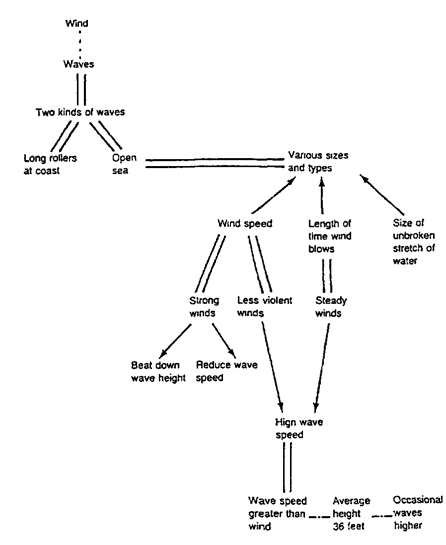
|
|
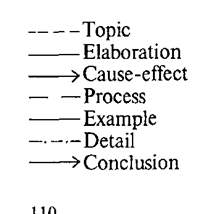
Figure 5 Flowchart of «Waves»
text (from Geva
1983: 387), from: «Interactive Approaches to Second Language Reading» Cavell
and Eskey
WAVES
Waves
are caused, as nearly everyone knows, by the wind.Two classes of
waves may be distinguished; the long rollers at the coast,
and the far more irregular forms of the open seas, where waves of all sizes and
types are present. The size and speed of waves depends not only on the wind's
speed but on the length of time the wind has been
blowing, and the unbroken stretch of water over which it blows as well. Very
strong winds tend to beat down the waves' height and to reduce wave speed. On
the other hand, less violent but steady winds often produce wave speeds greater
than that of the wind itself. The average maximum wave length
is about 36 feet, although occasional higher waves have been measured.

