LECTURE I. WORD POWER (VOCABULARY STUDY)
1. INTRODUCTION
TO WORD POWER (WP)
2. WORDS ON
WORDS
3. EVALUATE
YOUR WORD KNOWLEDGE
INTRODUCTION TO
WORD POWER (WP)
WP is about
words and word knowledge
It has been estimated by
some researchers (Nagy and Herman, 1984)* that a native speaker of English who
has completed 12 years of school encounters approximately 88,500 distinct word
families with upwards of 100,000 distinct meanings in reading in English.
According to Nagy and Herman, if materials for higher grades and for adults
were included, then these figures would be substantially higher. In their view,
the best way to acquire this necessary vocabulary is by reading, reading and
more reading! While it may be an unrealistic goal to expect to acquire all the words
one needs within the framework of one course or even two, it is possible to
improve one's word acquisition strategies and one's knowledge of and about
words. This is the purpose of this unit.
* Nagy, William E. and Herman, Patricia A. (1984)
«Limitations of Vocabulary Instruction» Technical Report No. 326 Center for the Study of Reading University of Illinois Urbana-Champaign.
Which words you learn is up
to you. You, the learner, have to build your own personalized vocabulary based
on what you feel is important to you. The information and exercises included
in the WP unit, along with the texts you read in the EFL course and the
readings in English on the bibliographies for your other courses, will increase
your English vocabulary. We hope all this will also improve your word knowledge
(i.e. what you know about how words are formed and how to figure out what new
words probably mean). Ultimately, we hope it will give you a feeling of word
power (WP).
WORDS ON WORDS
(Some Thoughts About How, and What, Words «Mean»)
Text A. (from
Through the Looking Glass by Lewis Carroll «Humpty Dumpty» — Chapter VI)
«When I use a word,» Humpty
Dumpty said, in rather a scornful tone, «it means just what I choose it to mean
— neither more nor less .»
«The question is,» said
Alice, «whether you can make words 5 mean so many different things.»
«The question is,» said
Humpty Dumpty, «which is to be master — that's all.»
Alice was too much puzzled
to say anything; so after a minute Humpty Dumpty began again. «... I can manage
the 10 whole lot of them! Impenetrability! That's what I say!»
«Would you tell me, please,»
said Alice, «what that means?» «... I meant by "impenetrability" that
we've had enough of that subject, and it would be just as well if you'd mention
what you mean to do next, as I suppose you don't mean to stop here 15 all the
rest of your life.»
«That's a great deal to make
one word mean,» Alice said in a thoughtful tone.
«When I make a word do a lot
of work like that,» said Humpty Dumpty, «I always pay it extra.»
Text B. (from
Lewis Carroll's Symbolic Logic, quoted on p.269 of The Annotated Alice, ed.
Martin Gardner)
...I maintain that any
writer of a book is fully authorized in attaching any meaning he likes to any
word or phrase he intends to use. If I find an author saying, at the beginning
of his book, «Let it be understood that by the word "black" I shall
always mean "white", and that by the word "white" I shall
always mean "black,"» I meekly accept this ruling, however
injudicious I may think it.
Text C. (from «The
Philosopher's Alice in Wonderland,» by Roger W. Holmes, in the Antioch Review,
Summer, 1959, also quoted in The Annotated Alice fp.2701)
«May we ... make our words
mean what we choose them to mean? One thinks of a Soviet delegate using
"democracy" in a U.N. debate. May we «pay our words extra,» or is
this the stuff that propaganda is made of? Do we have an obligation to past
usage? In one sense words are our masters, or communication would be
impossible. In another we are the masters; otherwise there could be no poetry.»
Text D. (from «Words,on Words,» the acceptance speech delivered by Vaclav
Havel, on receiving the Peace Prize of the German Booksellers Association on
October 15,1989; reprinted in «The New York Review of Books,» January 18, 1990)
(1) Words can have histories
too.
(2) There was a time, for
instance, when, for whole generations of the downtrodden and oppressed, the
word socialism was a mesmerizing synonym for a just world, a time when, for the
ideal expressed in that word, people were capable of sacrificing years and
years of their lives, and their very lives even. I don't know about your
country, but in mine, that particular word — «socialism» — was transformed long
ago into just an ordinary truncheon used by certain cynical, parvenu bureauc rats to bludgeon their liberal-minded fellow
citizens from morning until night, labeling them «enemies of socialism» and
«antisocialism forces.» It's a fact: in my country, for ages now, that word has
been no more than an incantation that should be avoided if one does not wish to
appear suspect.
(3) I was recently at an entirely spontaneous
demonstration ...protesting the sell-off of one of the most beautiful parts of
Prague to some Australian millionaires. When one of the speakers there, loudly
decrying the project, sought to bolster his appeal to the government by
declaring that he was fighting for his home in the name of socialism, the crowd
started to laugh. Not because they had anything against a just social order,
but quite simply because they heard a word which has been in-canted for years
and years in every possible and impossible context by a regime that only knows
how to manipulate and humiliate people.
(4) What a weird fate can
befall certain words! At one moment in history, courageous, liberal-minded
people can be thrown into prison because a particular word means something to
them, and at another moment, people of the selfsame variety can be thrown into
prison because that word has ceased to mean anything to them, because it has changed
from a symbol of a better world into the mumbo jumbo of a doltish dictator.
(5) No word — at least not
in the rather metaphorical sense I am employing the word «word» here —
comprises only the meaning assigned to it by an etymological dictionary. The meaning
of every word also reflects the person who utters it, the situation in which it
is uttered, and the reason for its utterance. The selfsame word can, at one
moment, radiate great hopes, at another, it can emit lethal rays. The selfsame
word can be true at one moment and false the next, at one moment illuminating,
at another, deceptive. On one occasion it can open up glorious horizons, on
another, it can lay down the tracks to an entire archipelago of concentration
camps. The selfsame word can at one time be the cornerstone of peace, while at
another, machine-gun fire resounds in its every syllable.
(6) Gorbachev wants to save
socialism through the market economy and free speech, while Li Peng protects socialism by massacring students, and
Ceausescu by bulldozing his people. What does that word actually mean on the
lips of the one and 50 the lips of the other two? What is this mysterious thing
— [«socialism»] — that is being rescued in such disparate ways?
Text
E.
Exercises:
I . In text (C) above, Roger
W. Holmes asks: «May we... make our words mean what we choose them to mean?»
1. How does Holmes himself
answer this?
2. Compare Holmes' position
on this issue with that of Lewis Carroll (in text В above). Which of
the two do you find more persuasive?
3. Why do you suppose Lewis
Carroll qualified what he said by adding at the end of his declaration,
«however injudicious I may think it»? (What did he realize might turn out to be
«injudicious»?)
4. How do you imagine Vaclav
Havel (in text D) might answer the same question?
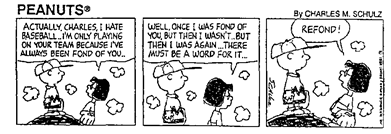
5. How does the girl in the
peanuts cartoon answer it?
6. What words that have
«histories» (see the first sentence of Havel's speech) can you think of?
II. A. Carroll tells us (in
text В above) that if a writer wants to use a word to mean
something different from what it commonly means, he need only tell us, at the
beginning of his text, what special meaning he has assigned to that word in his
text. But what if a writer does not prepare his reader in this way? By what
other means can we guess what meaning he has assigned to a word that he has
used in an unusual way (one that cannot be found in any dictionary?)
1. One possibility is
illustrated in the short Text (Part III) called «Filters Against Folly.» The
writer speaks of a «shortage of supply and a longage
of demand» (1.4). The technical term for the rhetorical device used here by
this writer is «parallelism.» What do you think «parallelism» means? How do we
know what he means by longage, even though the word
does not appear in any dictionary?
2. We can also guess
something about the meaning of a word by its position in the sentence, or by
its ending. This can be helpful in understanding something about what a writer
is telling us, even when we're not familiar with many of the words he uses.
a. To understand something
about the meaning of a word by its position in the sentence, we have to know
the parts of speech (noun, verb, adjective, adverb, etc.)-and how they function
in an English sentence.
For example:
— The first word in a
sentence will usually never be a verb. But an unfamiliar word that follows one
of the familiar modals (can, may, must, would, etc.) probably is a verb (e.g. ,
He may abscond with the money) , though the modal may be followed by an adverb
(e.g. , He may never abscond with the money). -An unfamiliar word following any
of the determiners (i.e., the articles «the», «a», «an», «some», «any»: the
possessive pronouns such as «my», «your», etc. ; the demonstratives «this»,
«that», «these», and «those»; and the counters or measuring words such as
«few», «many», «several», etc.)-is probably a noun of some sort (e.g. , Behold
the Aardvark ingesting termites). -A word ending in «ly»
is likely to be an adverb (e.g. , He is demonstrably idiotic), followed by an
adjective; though it could also be an adjective (e.g., He was a friendly
creature) , followed by a noun. For the meaning of grammatically significant
word endings such as «ly», see «Suffixes Used to Form
Parts of Speech» in the Appendix to Part I (WP).
II. B. Below are a set of
sentences with nonsense words. In the blanks provided, replace each nonsense
word with some meaningful word, so that the resulting sentence is well-formed
and meaningful. Use your knowledge of the meaning aspects of word forms and
their functions in English.
1. The clonks
were wimbling pootishly.
The_______
were______ ing______ ly.
2 . Have you beller spiggled a _____?
Have you______er______ ed a _____?
3. This om the bodgiest puckle in the Hitch.
This______the ____iest ______in the ___
.
4. Greezzy fubbles should blably be shifted.
____ у______s
should _____ly be _____ ed.
5. You can skritch your Cripples and plutch
them into your trinks . You can____________ your_______s
and_____them into your______s .
What clues did you use to
decide what parts of speech to choose to fill in the blanks?
II. C. In his novel, The
Clockwise Orange, Anthony Burgess created a special lexicon (i.e., a list of
words with their meanings) for his characters. To be understood, he depended
upon his readers' background knowledge of the criminal world (presumably
acquired second-hand, from reading and seeing «thrillers»). But he also
depended upon their knowledge of the forms and functions of words in ordinary
English.
What sense can you make of
the following passage taken from The Clockwork Orange?
Then we slooshied
the sirens and knew the millicents were coming with pooshkas pushing out of the police auto-windows at the
ready. That little weepy devotchka had told them
there being a box for calling the rozzes not too far
behind the Muni Power Plant.
EVALUATE YOUR WORD KNOWLEDGE
How large is your English
vocabulary? Do you need to have precise knowledge of every word in order to be
able to understand a text? Is it sometimes enough to have only a vague idea
about some of the words? Is it sometimes all right to ignore a difficult word,
hoping you will be able to figure out what it means after further reading?
1. Evaluate your word
knowledge (decontextualized). The following words
come from Sublist 1 of A University Word List,
prepared by Xue Guo-yi and
Paul Nation, reprinted in Language and Communication, 3(2), 1984).
How well do you know each of
them? (place the appropriate symbol before each word.)
i. 0 = no knowledge,
ii. ? = some knowledge,
iii. + = knowledge (discriminating knowledge, i.e.
you can translate it, can give a definition, can understand it fully in reading
and can use it productively in writing.)
|
alternative arbitrary assume concept constant criterion denote dimension element equivalent evident guarantee ignore imply interpret method negative presume publish range restrict specify suffice tense valid |
analyse assess compensate conclude construct data derive distinct environment establish facilitate hypothesis illustrate indicate involve minimum obvious prime pursue region role status summary ultimate vary |
approach assign complex consist context define devise dominate equate evaluate formula identify impact initial magnitude modify potential proceed random require similar subsequent technique usage vertical |
2. Underline ten difficult
words in one of the texts in this book as you read it, and before you reach for
a dictionary.
A. How important is it for
you to know each of these words in order to understand the text? (Evaluate the
importance on a scale of 1-5: (O) = of no importance; (5) — crucial)
B. How important is it for
you to know these words for your general/personal vocabulary? (Evaluate the importance
on a score of 1-5: (О) — of no importance; (5) = crucial)
3. Strategies available for
learning and remembering a new word:
1.
Internal context (analysing word structure — prefixbase — suffix)
2.
Association of the new word with words that look the same (i.e., have the same
base, or stem)
3.
External context (studying the words, phrase or sentence(s) just preceding or
just following the unfamiliar word)
4.
Aural and/or visual cues (associating the word with some sound or image)
5.
Native language equivalents (associating the word with its equivalent in your
native language)
6.
Synonyms (associating the word with word(s) of similar meaning )
7.
Antonyms (associating the word with word(s) of opposite or contrastive meaning)
8.
Collocations (associating the word with words that go together with it, i.e.
coffee or tea)
9.
Placing the word within a semantic field — (groups of words used in relation to
a given topic or scene)

