Semester
4, Lesson 10 (55)
WHAT
IS human resource management?
I. Read the following words
and word combinations. Try to match up each of them to its Ukrainian equivalent. Use your dictionary if necessary.
|
a)
to forecast b)
to develop c)
skill d)
to recruit e)
to select f)
concerned with |
g)
to bring h)
appropriate i)
performance j)
appraisal k)
to evaluate l)
accomplishment |
m)
to reward n)
compliance with o)
reason p)
sound q)
to ensure r)
to meet |
s)
need t)
to design u)
to implement v)
workforce w)
competitive |
|
а) винагороджувати б) виконувати
в) доброякісний г) забезпечувати д) набирати е) конкуруючий є) уміння,
майстерність ж) відповідність
(чомусь) з) прогнозувати и) вибирати,
відбирати і) причина ї) потреба к) планувати |
л) приводити,
доставляти м) задовольняти (щось), відповідати
(чомусь) н) виконання о) розвивати(ся) п) працівники,
робоча сила р) досягнення с) оцінювати т) оцінка
у) придатний ф) що має відношення до (чогось), що займається (чимось) |
2. Which verbs in A can go with which nouns in B?
E.g. to forecast the number of employees
A
|
to forecast to develop to recruit to carry out to evaluate to reward to meet to implement |
B
|
best employees HR programs work accomplishments the skills the number of employees individuals the work
the needs |
II. 1. Read and translate text 26:
TEXT 26 The
nature of human resource management
Nature of human resource management (HRM) includes activities that first
forecast the number and type of employees an organization will need, then find,
and develop employees with necessary skills.
For example, human resource planning, recruiting, and selecting are
programs concerned with bringing the appropriate individuals into the
organization. Orientation and training programs develop the skills required by
employees to carry out the work of the company. Performance appraisal evaluates
work accomplishments, while compensation can reward those who perform at high
levels.
Compliance with the law is also important, but such compliance is not the
major reason for developing sound human resource programs. The primary reason
is to ensure a sufficient number of employees who have the appropriate skills
to meet the organization’s needs.
If these HR programs are appropriately designed and implemented, the
organization will have an efficient workforce that serves as a primary strength
in competitive markets.
2. Comprehension check.
Are the following statements
true or false? Correct the false ones.
a)
One of the functions of human
resource management is to predict the organization’s future demand for
staff.
b)
Selecting programs involve
developing the proficiency necessary for doing the work of the company.
c)
Performance assessment is the
judgement about how an employee is working.
d)
The main goal of working out a
good human resource program is to comply with the law.
e)
The company’s effective
employees act as a key force in competitive markets.
3.
Read the text once again. Find
words in the text that mean the same as the following.
|
a. actions |
g. institution |
n. employment |
u. demand |
|
b. cause |
h. involves |
o. assesses |
v. put into practice |
|
c. requirements |
i. planned |
p. functioning |
w. proficiency |
|
d. main |
j. effective |
q. do |
x. assessment |
|
e. achievements |
k. proper |
r. administration |
y. high-class |
|
f. staff (three words) |
l. improve |
s. choosing |
z. involved in |
|
m. predict |
t. instruction |
|
III Match up each of the words
and phrases in A to its synonym or an explanation for it in B. Use your
dictionary if necessary.
A B
|
1.
organization |
a.
to make a choice |
|
2.
work-related |
b.
qualified |
|
3.
to make a decision |
c.
a company that sells the
same goods or services as another company |
|
4.
reason |
|
|
5.
to face |
d.
to try to be more successful
|
|
6.
competitor |
e.
to take action to do smth |
|
7.
costs |
f.
to influence |
|
8.
to compete |
g.
connected with work |
|
9.
skilled |
h.
personnel |
|
10.
to deal with |
i.
to provide what is necessary
|
|
11.
issue |
j.
work that is done to keep sth in good condition |
|
12.
to affect |
|
|
13.
complex |
k.
to meet |
|
14.
to meet the needs |
l.
to discover |
|
15.
workforce |
m.
existing |
|
16.
to be concerned with |
n.
to involve |
|
17.
maintenance |
o.
common |
|
18.
to find |
p.
problem |
|
19.
general |
q.
cause |
|
20.
current |
r.
company |
|
21.
to concern |
s.
difficult |
|
t.
to give attention to smth because it is important |
|
|
u.
expenses |
IV. Work in small groups.
Say which of the following
suggestions would be appropriate activities or inappropriate activities for a
human resource manager.
If I were a human resource manager...
a.
... I would be responsible for
lowering labour costs.
b.
... I would have to make laws
affecting employment decisions.
c.
... I would make every effort
to meet the needs of the organization for an effective work force.
d.
... I would fire unqualified
employees.
e.
... I would try to find
skilled employees in the general work force.
f.
... I would be in charge of
developing skills in current employees.
1. Skim through text 27 and
think of the suitable title.
TEXT 27 TEXT
2
A basic
activity of HR managers is collecting information to use in making job-related
decisions about individuals. Most HR programs use some combination of three
types of information: job characteristics, worker qualifications, and job
performance.
Job analysis
is the systematic process of gathering information about important work-related
aspects of a job. It identifies the first of two types of information, which
includes the tasks that make up the job; the worker knowledge, skills, and
abilities (KSAs) needed on the job; the information, equipment, and materials
used; and the working conditions.
Table 1
provides some example task statements and KSAs that are appropriate for the
position of regional sales manager.
Performance
appraisal, discussed in a later section, is the process of collecting the third
type of information, job performance of individual employees.
Table 1
A partial list of tasks and
KSAs for the position of regional sales manager
|
Job Tasks |
1.
Use data from last year’s
sales, the present state of the economy, and the number of competitors in the
region to develop a sales forecast for each product item for the next six
months. 2.
Interview applicants for
sales positions and, together with the district sales manager, decide which
applicants to select. Use training and experience forms, ability tests, and
performance tests. 3.
Develop promotion and sales
campaigns using data from the sales forecast, recent sales, company-sponsored
market surveys, and competitors’ promotion and sales practices. |
|
Knowledge, Skills, and Abilities Needed |
Knowledge of algebra Ability to use situational interviewing
for selection of sales staff Ability to design a
promotion campaign for each product for a six-month time period Skill in use of personal
computer for word processing and development of mathematical tables for sales
forecasting |
2. Comprehension check.
Working in pairs, answer the
questions.
a)
What information must be
collected to have full characteristics of job?
b)
What does the abbreviation
KSAs mean?
c)
What must a good sales manager
be proficient in?
d)
What must a regional sales
manager do to work out a sales forecast for each product item?
e)
What does a regional sales
manager need a sales forecast for?
f)
In what way does a regional
sales manager select applicants for sales positions?
You are going to be
interviewed for the position of HR manager. To be well prepared, you need to
make a table showing duties and KSAs that are required for this job.
VII Individual work: Read the texts, translate and answer the questions:
TEXT 28 People management
HRM has become the dominant approach to
people management throughout much of the world. But it is important to stress that HRM has not ‘come out of nowhere’. There is a long history
of attempts to achieve an understanding of human behaviour in the workplace.
For a century and more, practitioners and academics
have developed theories and practices to explain and influence human behaviour at work. HRM has absorbed ideas and techniques from a wide range of these theories and practical tools. In effect, HRM is a
synthesis of themes and concepts drawn
from a long history of work, more recent management theories and social
science research.
Over and over again, managers
must deal with events that are clearly
similar but also different enough to require fresh thinking. For example:
●
businesses expand or fail
●
they innovate or stagnate
●
they may be exciting or unhappy organizations in which to work
●
finance has to be obtained
●
workers have to be recruited
●
new equipment is purchased, eliminating old procedures and introducing new methods
●
staff must be reorganized,
retrained or dismissed.
Some items we have listed are clearly to do with people management (for
example, recruiting or reorganizing
staff). Others – such as innovation or stagnation – are less obviously so. However, they are likely
to be affected by having
trained, motivated people
with suitable skills in place. Some seem irrelevant to HRM, and you might
have identified ‘raising
finance’ in this
category. But compare two businesses: one has an excellent industrial relations record with no strikes or disputes, while
another has many such problems that have been reported in the media. For which
company would you find it easier to raise extra finance? Businesses are made up of people
and there is no business
activity that might
not be touched on by HRM.
Human resource management draws on many sources for its theories and practices. Sociologists, psychologists and management theorists, especially, have contributed a constant stream of new and reworked ideas. They offer
theoretical insights and practical assistance
in areas of people management such as
recruitment and selection, performance measurement, team composition and organizational design. Many of their concepts
have been integrated into broader approaches that have contributed to management thinking
in various periods
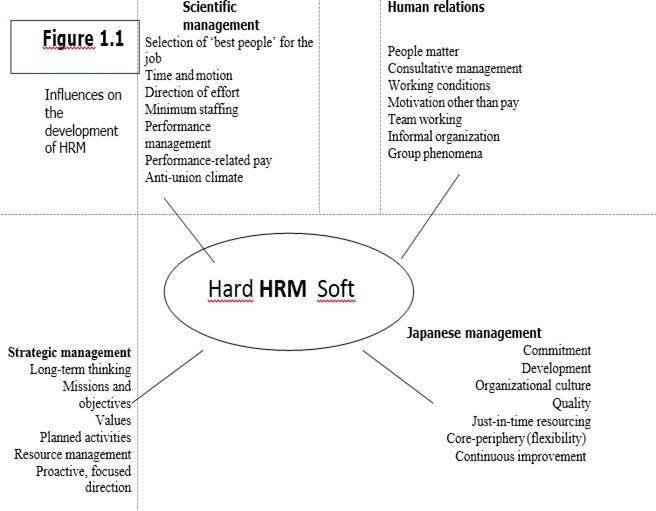
and ultimately the development of HRM (see Figure 1.1).
1. Answer the questions
1. Who has developed theories and
practices to explain and influence human behaviour at work?
2. What events must managers deal with?
3. What listed in the text events are clearly to do with people
management?
4. What specialists contributed a constant stream of new and reworked ideas into
human resource management?
5. What are the influences on the development of HRM
(see Figure 1.1)?
TEXT 29
Background and origins of people management
The roots of people management and, therefore, of HRM lie deep in the past.
Just as the tasks that have to be done in modern organizations are allocated to different jobs and the people who perform those jobs, humans in ancient
societies divided work between themselves. The division of labour (see Key concept 1.1) has been practised since prehistoric times: family groups shared the work of hunting and gathering; tasks were allocated
according to skills such as ability to find food plants,
track animals or cook; age, strength and health were taken into account and the oldest and youngest members were not expected to travel
far from home or to be involved in the dangers of hunting.
Social customs determined separate roles and tasks for males and females. Traditional self-sufficient communities,
dependent on agriculture or fishing, rarely had
more than 20–30 categories of labour, in contrast
to modern industrial states that have thousands of different job types. Some functions,
such as religious and political leadership or medicine, were restricted to
individuals with inherited or specialist knowledge. As civilization and
technology evolved, however, specialization led to a proliferation of different
forms of work, and farmers and fishermen were joined by skilled craftworkers using metal, pottery, and wood.
Every generation believes
that its problems
and achievements are greater than those of the past. Modern business is seen as being uniquely
complex and on a larger scale than the enterprises of earlier times but, in the
ancient world, large numbers of people were organized to build great
pyramids, fortresses and irrigation systems;
military leaders marshalled huge armies; slave
owners operated massive plantations and mines. Leadership, power and organization, therefore, have been matters of study and debate for thousands of years. The Farmer’s Almanac, a 5000-year-old Sumerian text,
includes useful tips on the supervision of farm labourers –
making it the oldest known
HRM textbook (Kramer, 1963:
p.105). The text advised the farmer to prepare a selection of whips and goads to keep men
and beasts working hard. No idleness
or interruptions were to be tolerated. Even planting barley seed had to be closely supervised as the unfortunate labourers
were not trusted to do it properly.
This authoritarian approach
has predominated throughout most of recorded
history, but there has been a continuing and increasing search
for less coercive
ways of managing
people.
|
Key concept 1.1 Division of labour The subdivision of work so that specific tasks or jobs are allocated to individuals deemed
most suitable on the basis of skill, experience or cultural tradition.
All societies practise division of labour. Some
cultures traditionally allocated tasks to particular social groups, such as the caste
system in India.
In others, higher
status jobs have been reserved for the members of a power elite such as the products of the British
‘public school and Oxbridge’ system or the French ‘grandesécoles’. Modern
HRM aims to identify and develop the best people for specific jobs, regardless of
background, class or gender. |
|
|
In 16th century Italy, for example,
Niccolo Machiavelli (1469–1527) wrote The Prince (by which he meant a leader), detailing
a wide range of strategies and tactics that continue to offer insights into the exercise
of power. Although famous for advocating ruthlessness in the conduct of public (i.e.
political) activities, Swain (2002) considers Machiavelli to be the originator of three themes more relevant to private management: modernity, publicness and the executive. According to Swain (2002, p.281) Machiavelli’s modernity
distinguished his world from that of antiquity:
When Machiavelli jettisons the Christian religion and ancient philosophy
as sources of guidance in the human condition, he may do so for the
sake of politics, but the ramifications spill over into all other aspects of
human life. The modern enterprise, simply put, is humankind taking care of itself as best it can in an otherwise pretty lonely universe. Science and
technology are harnessed to make life more pleasant. Politics and
political orders are mostly guided by the ends of political stability and serving humankind’s needs.
According to Machiavelli, the ideal leader should have a degree of
virtue and be regarded with both fear and love – although, if
only one was possible, it was better to be feared than loved. Amongst
his other prescriptions, the leader should be both a Fox and a Lion, able to exercise cunning and be a champion.
The division of labour required the most
suitable people to perform skilled tasks, producing an early interest
in the differences between individuals. According to Smith (1948, p.10):
In the 16th century John Huarte wrote a book
in Spanish concerning what we should now refer
to as vocational guidance and
selection. It was translated into Italian, and from this version an English translation was made under
the title of ‘The Tryal of Wits’,
which, translated into modern speech, means the testing of
intelligence. He maintained that it is nature which enables a man of ability to learn, and that it is quite superfluous for good teachers to
try to teach any particular subject to a child who has not the
disposition or the ability required for it. Each person, unless he is
a dolt, has some predominant quality which will enable him to excel in some way.
Huarte produced the following classification (Smith,
1948, p.11):
1
Some have a disposition for the clear and easy parts, but cannot
understand the obscure and difficult.
2
Some are pliant and easy, able
to learn all the rules, but no good at argument.
3
Some need no teachers, they take no pleasure in the plains but seek
dangerous and high places and walk alone, follow
no beaten track; these must fare forthwith, unquiet, seeking to know and
understand new matters.
Individuals perform their jobs within a wide environmental context.
In 1776, Adam Smith (1723–1790) published An Inquiry into the Nature and Causes of the Wealth of Nations. This foundation text for the science of economics began by emphasizing the importance of the division of labour in achieving increased productivity, thereby anticipating the Industrial Revolution. The UK is conventionally regarded
as the first country to experience this process which then spread throughout
Europe and North America and continues to transform developing countries. However,
Cannadine (1992, p.18) observes that:
The view that Britain was the first industrial nation, whose achievements
all others consciously emulated, has also been severely
undermined, especially in the case of France where, it is now argued, industrialization was taking place in a different way and where,
in any case for much of the eighteenth century, its productivity was higher than Britain’s.
‘Revolution’ implies a rapid transition from craft to industrial methods
but British industrialization was a
relatively slow process in comparison with the recent development of the ‘tiger’ economies of east Asia. At the end of the 18th, and the beginning
of the 19th centuries, workers were gradually
concentrated in factories and work centres, more or
less under their own free will. This concentration was linked to increasing mechanization and the consequent need for machine-operating skills. Developing from older
craft-based industries, work was divided between employees according to the nature
of their skills.
One worker would
no longer be totally responsible for all stages of production, such as making a piece of furniture
|
Key concept 1.2
Alienation |
|
A state of estrangement, or a feeling of being an
outsider from society. Karl Marx observed that although work in a traditional,
agricultural or craft-based society had been
exhausting, workers had
control over their own jobs. Their work required considerable knowledge and skill that
had been removed from many factory jobs. Dull, boring
and repetitive work
induces a feeling of alienation. Assembly line workers are involved with
a small part
of the final
pro- duct, have
little control over
the rhythm of
their work and
may have no
idea of the
significance of their
contribution. Their work can appear to be alien with no relationship or
meaning to their lives other than to produce income.
As a consequence they may feel little enthusiasm and, often,
active hostility towards what seems like
forced labour. |
In the industrial system the task was subdivided into simpler,
less skillful jobs.
Different people would
deal with parts
of the process: one would
turn chair legs,
another would prepare
seats, yet another would stain and
polish, and so on.
By the late 19th century, the size and complexity of the new industries demanded more sophisticated methods
of control and organization, eventually evolving into modern management. Until this time, workers were not directly
employed by large capitalists: their employers were gang bosses, subcontracted to provide and organize labour. In the developed world,
sub- contractors of this kind continue to exist in the building sector and in fruit and vegetable- picking. In developing countries their power is even greater.
Under autocratic but lost control, skilled or unskilled workers largely organized their own efforts,
forming autonomous teams. However, as factories grew larger and people were concentrated
in greater numbers in specific locations, this indirect approach
became increasingly unworkable. People were needed to control permanent workforces, which were directly employed by
factory owners.
Initially they took the form of overseers, foremen or supervisors;
exercising ‘coercion by means of observation’ (Foucault,
1977, p.175). At first they were
people promoted from the workforce: the concept of a distinct
managerial class with separate recruitment paths evolved slowly. Jacques (1997) points out that ‘the foreman was not in any sense a
middle manager, but a key player in a form of control in the works radically different
from and preceding management.’
In the 19th century industry was dominated by individual owners, family
businesses and partnerships. The principals of these companies
managed their businesses in a direct,
personal way, partly because
the numbers of people involved
were small enough to be within the span of control of a few individuals. Family-controlled businesses became
a major economic
force and many achieved considerable importance. Some of the most successful were happy to publicize their methods
and were featured
in the media of the time. Biographies were written glorifying their achievements and
presenting their ideas in largely uncritical terms. George Cadbury is one
such example and he is featured in the case study at the end of this chapter. Along with explorers, scientists and colonial adventurers, business
heroes were presented as role models for the masses. Such
books met the demands of a reading population who preferred to perceive
the world in terms of good and bad, heroes and villains,
and required a presentation of success in simplistic terms.
Examination of modern
‘pop management’ books suggest that little has changed.
VIII.
Grammar
Unreal Past
The past tense is
sometimes used in English to
refer to an 'unreal' situation.
So, although the tense is
the past, we are usually
talking about the present, e.g.
in a Type 2 conditional sentence:
If an elephant and
a mouse fell in
love, they would have many
problems.
Although fell is
in the past
tense, we are talking about
a hypothetical situation that might exist
now or at
any time, but we are not referring to the past.
We call this
use the unreal past.
Other situations where this occurs
are:
·
after other words
and expressions like 'if' (supposing, if only, what if);
·
after the verb 'to
wish';
·
after the expression 'I'd
rather..'
Expressions like 'if'
The following expressions can be used
to introduce hypothetical situations:
- supposing, if only, what if.
They are followed by a past tense to indicate that the condition
they introduce is unreal:
Supposing an elephant and
a mouse fell in love? (= but we
know this is unlikely or
impossible)
What if we painted the room purple?
(= that would be very surprising)
If only I had more money.
(= but I haven't).
These expressions can also introduce hypothetical situations in the past
and then they are followed
by the past perfect.
Examples
If only I hadn't kissed the frog (= I did and it
was a mistake because he turned
into a horrible prince, but I can't
change it now.)
What if the elephant had
trodden on the mouse? (She didn't,
but we can
imagine the result!)
Supposing I had given that man my money!
(I didn't, so I've still got
my money now.)
The verb to wish
The verb to wish is followed by an 'unreal' past
tense when we want to
talk about situations in the
present that we are not
happy about but cannot change:
I wish I had more money (=but
I haven't)
She wishes she was/were beautiful (= but she's not)
We wish we could come to your
party (but we can't)
When we want to
talk about situations in the
past that we are not
happy about or actions that
we regret, we use the
verb to wish followed by the past perfect:
I wish I hadn't said that (= but I did)
He wishes he hadn't bought the car (= but he
did buy it.)
I wish I had taken that job in New
York (= but I didn't, so I'm
stuck in Bristol)
NOTE: When we want to talk
about situations we are not
happy about and where we
want someone else to change them, we use to wish followed by would + infinitive:
I wish he would stop smoking. (= I don't like it, I want him to change it)
I wish you would go away.
(= I don't want you here, I want you to take some action)
I wish you wouldn't squeeze the toothpaste from the middle! (= I want you to
change your habits.)
I'd rather and it's
time...
These two expressions are also followed
by an unreal past. The verb
is in the
past tense, but the situation
is in the
present.
When we want to
talk about a course of action
we would prefer someone else to take,
we use I'd rather + past tense:
I'd rather you went
He'd rather you called the police
I'd rather you didn't hunt elephants.
NOTE: the stress can be important
in these sentences, to show
what our preference is:
I'd rather you went = not me,
I'd rather you went = don't stay
He'd rather you called the police = he doesn't want
to
He'd rather you called
the police = not the ambulance
service
Similarly, when we want
to say that now is a suitable moment to do
something, either for ourselves or
for someone else, we use it's time + past tense:
It's (high) time I went.
It's time you paid that bill.
Don't you think it's
time you had a haircut?

