Semester 4, Lesson 4 (49)
MARKETING – WHAT’S IT ALL
ABOUT?
I. Read the following words and word
combination and learn their meanings by heart:
Business dealings [`di:liNz] ділові стосунки, торговельні угоди; traffic [`trxfik] торгівля, переміщення;
customer [`kAstqmq] покупець, клієнт; a
producer [prq'djHsq]
виробник; a consumer [kqn'sjHmq] споживач;
marketing ['ma:kitiN]
маркетинг, збут, продаж; storage ['sto:riG] зберігання;
a price [prais] ціна;
promotion [prq'mouSn] of goods - впровадження
товару, сприяння у продажу; demand [di'ma:nd] попит, a need - потреба marketing
mix - маркетинговий комплекс;
location [lou'keiSn]
розміщення; advertising [`xdvqtaiziN] рекламування; likings [`laikiNz] смаки, уподобання,
introduction [іntrq'dAkSn]
впровадження; maturity [mq'tjuqriti]
зрілість; decline [di'klain]
занепад, спад; to rise [raiz] (prices) - підніматися,- to
fall [fO:l]
(prices) – падати, to persuade[pq`sweId] вмовити, агітувати, to obtain - одержувати,
flow- потік, to achieve - досягати
II. Read and translate text 10, ask
questions to the underlined sentences:
TEXT 10 MARKETING
Marketing is
an activity that includes different kinds of business dealings connected with
the movement of goods and services from producer to consumer. It surrounds our everyday life.
Marketing is
a very complex process. It includes such activities as product planning,
storage, buying, pricing, promotion, selling, traffic, distribution of ideas
and research.
Marketing is
a social and managerial process by which individuals and groups obtain
what they need and want through creating and exchanging products and
value with others.
According to Peter Drucker: "Marketing is the performance of business activities
that direct the flow of goods and services from producer to
consumer."
The aim of
marketing is to know and understand the customers so well that the product or
service fits him and sells itself.
The ability
to know some new wants and demands of customers, to recognize new trends and
developments is very important in marketing. Those who produce must know what
goods and services, where, for what prices, why, for what purpose their
customers would like to buy. Marketing research in this respect helps producers
very much.
The ABC of
marketing is the so-called Marketing Mix. It includes the Four P's: product,
price, place and promotion.
Place means
the location of certain goods and services as well as distribution of them.
Promotion includes all kinds of communication in marketing, say, advertising,
sales, direct mail, free additions, testers, fairs and shows to
advertise new products and services, telemarketing with telephone sales, newspaper
ads, etc. Promotion is considered to be, perhaps, the most complex element
in the Four P's, because different groups and sections of people have different
likings and dislikings.
The third
element in Marketing Mix is Product (Service). It is often connected with
research and development of a new product or service, testing it to know for
quality, searching the potential markets and, after all, introduction to
the market.
Each product has its own "product life cycle". These cycles are different for different
products, however, there are 4 stages of "life cycle" for each
product. They are: introduction, growth, maturity and decline.
It should be
noted that Product is the most controllable of the four elements of marketing
Mix.
The most
changeable element of all the four is Price. The definition of price is
exchange of something of value for something else. It is as simple as that. And
it is very important for customers. As prices rise we can buy fewer things
or only things of lesser quality. On the contrary, as prices fall
customers can buy more things or things of better quality.
III. Retell the text according to the following questions:
l.What is marketing? 2.What does it include? 3.What is the aim of marketing?
4.What is very important in marketing? 5.What elements does Marketing Mix
include? 6.What does place in the Four P's mean? 7.What does promotion include?
8.What is the third element in Marketing Mix connected with? 9. What are four
stages of "product life cycle"? 10. What is the most changeable
element of all the four?
IV.
Try to repeat a tongue twister
several times, as quickly as possible, without stumbling or mispronouncing: A pleasant place to place a
plaice is a place where a plaice is pleased to be placed.
А plaice[pleis]-
камбала.
V. Learn the following groups of:
a) synonyms:
Price - cost, need - want -
demand, to obtain - to get - to receive, different - various, to keep in mind -
to remember, salary - wage, expen-diture - outlays,
to connect - to link, research - investigation, customer - buyer.
b) antonyms:
Producer - consumer, buying -
selling, likings - dislikings, complex - simple,
include - exclude, rise - fall, expenditure - income, decline - prosperity,
well-being.
VI. Make up sentences.
a) is, called, marketing,
sometimes, distribution.
b) the business, all,
includes, marketing, activities.
c) is, to recognize, the
ability, important, very, early trends.
d) expensive, are, marketing,
operations, very.
VII. Ask for your friend's opinions
concerning the following statements:
1. The main aim (goal) of any
business is to get profit, first of all. 2. Both production and distribution
are equally important for business. 3.Some people prefer to work with
partnership, some other prefer to work with corporation. And some like to go
into their own small business. What is better? 4. Some people think that the
most responsible job is that of a director of a firm, who is a senior manager.
There is an opinion that the most responsible job is that of the chief
executive officer (CEO).
|
VIII. Read
and translate text 11, find the infinitives in it: TEXT 11 MARKETING – WHAT’S IT ALL ABOUT? |
|
If forced to define marketing, most people, including some business
managers, say that marketing means “selling” or “advertising”. It’s true that
these are parts of marketing. But marketing is much more than selling
and advertising. |
|
To illustrate some of the other important things that are included, in
marketing, think about all the tennis rackets being swung with varying
degrees of accuracy by tennis players around the world. Most of us weren’t
born with a tennis racket in our hand. Nor do we make our own tennis rackets.
Instead they are made by firms like Wilson, Spalding, Head, and Prince. Most tennis rackets are intended to do the same thing – hit the ball
over the net. But a tennis player can choose from a wide assortment of
rackets. There are different shapes, materials, weights, handle sizes, and
types of strings. You can buy a pre strung racket for less than $15. Or you
can spend more than $250 just for a frame! This variety in sizes and materials complicates the production and sale
of tennis rackets. The following list shows some of the many things a firm
should do before and after it decides to produce tennis rackets. 1. Analyze
the needs of people who play tennis and decide if consumers want more or
different tennis rackets. 2. Predict what types of rackets – handle sizes,
shapes, weights, and materials – different players will want and decide
which of these people the firm will try to satisfy. 3. Estimate how many of these people will be playing
tennis over the next several years and how many rackets they’ll buy. 4. Predict exactly when these players will want to buy
tennis rackets. 5. Determine where these tennis players will be –
and how to get the firm’s rackets to them. 6. Estimate what price they are willing to pay for
their rackets – and if the firm can make a profit selling at that price. 7. Decide which kinds of promotion should be used to
tell potential customers about the firm’s tennis rackets. 8. Estimate how many competing companies will be making
tennis rackets, how many rackets they’ll produce, what kind, and at what
prices. The above activities are not part of production – actually making
goods or performing services. Rather, they are part of a larger
process – called marketing – that provides needed direction for
production and helps make sure that the right products are produced and find
their way to consumers. Our tennis racket example shows that marketing includes much more than
selling or advertising. For now, it’s enough to see that marketing plays an
essential role in providing consumers with need-satisfying goods and
services. |
IX. Read and translate the meanings of the following terms. Translate the
sentences with them.
Purchase [`pWCIs]- 1) is the
action of buying something; 2) is the thing bought.
1. This receipt is your proof of purchase. 2. Choose carefully before
making a purchase. 3. Employees are encouraged to purchase shares in the firm.
4. I have some purchases to make in town.
Bargain [`bRgIn](verb) - 1) is to discuss or argue the price of something; 2) is to
discuss or argue the terms and conditions of something;
1. They bargained all day about prices. 2. The dealers bargained over the
share price. 3. The union bargained for better pay and working conditions. 4. 1
shall bargain with the trader.
Bargain (noun) - 1) is an agreement, made between two
people or groups, to do something in return for something else; 2) is something
bought cheaply or for less than its usual price.
1. I might buy a TV, if I can find a bargain in the sales. 2. These shoes
are a bargain at $ 22. 3. We've made a bargain that he'll do the shopping and
I'll cook.
X. Translate the sentences into English in written form:
1. Маркетинг
- це діяльність, пов'язана з рухом товару від виробника
до споживача. 2. Маркетинг включає транспортування, складування, рекламу, калькуляцію цін, продаж. 3. Вивчення ринку допомагає виробникам передбачити загальні потреби споживачів. 4. Реклама дуже сильно
впливає на покупця. 5. Ми не можемо встановлювати
найнижчу ціну на цей товар.
6. Необхідно розробити план виробництва нових продуктів. 7. Прямий обмін товарами
неможливий у розвинутому суспільстві. 8. Для того, щоб розвивалася
торгівля, повинен існувати маркетинг. 9. Ми успішно провели
переговори про ринок збуту.10. Маркетинг-це більше ніж продаж
чи реклама.
XI. Translate the following extract in written form:
What exactly
is marketing and why is it important to you as an entrepreneur? Simply
stated, marketing is everything you do to place your product or service in the
hands of potential customers.
It includes
diverse disciplines like sales, public relations, pricing, packaging, and
distribution. In order to distinguish marketing from other related
professional services, S.H. Simmons, author and humorist,
relates this anecdote.
"If a young man tells his date she's intelligent, looks lovely, and is
a great conversationalist, he's saying the right things to the right person and
that's marketing. If the young man tells his date how handsome, smart and
successful he is — that's advertising. If someone else tells the young
woman how handsome, smart and successful her date is — that's public
relations."
You might
think of marketing this way. If business is all about people and money
and the art of persuading one to part from the other, then marketing is all
about finding the right people to persuade.
Marketing is
your strategy for allocating resources (time and money) in order to achieve your
objectives (a fair profit for supplying a good product or service).
Note: Date - a) an appointment for a particular time, esp
with a person to whom one is sexually or romantically attached b) the person
with whom the appointment is made.
XII. Individual work. Read a
joke: What is Marketing? (Exercise: Change
direct speech into reported speech.)
1. You see a gorgeous girl at a party. You go up to her and say: ‘ I am very
rich. Marry me! ‘ – That’s Direct Marketing’
2. You’re at a party with a bunch of friends and see a gorgeous girl. One of
your friends goes up to her and pointing at you says: ‘ He’s very rich. ‘Marry
him.’ -That’s Advertising’
3. You see a gorgeous girl at a party. You go up to her and get her telephone
number. The next day, you call and say: ‘ Hi, I’m very rich. ‘Marry me – That’s
Telemarketing’
4. You’re at a party and see gorgeous girl. You get up and straighten your
tie, you walk up to her and pour her a drink, you open the door (of the car)for
her, pick up her bag after she drops it, offer her ride and then say:’By the way, I’m rich. Will you ‘Marry Me?’ – That’s
Public Relations’
5. You’re at a party and see gorgeous girl. She walks up to you and says:’You are very rich! ‘Can you marry me?’ – That’s Brand Recognition’
6. You see a gorgeous girl at a party. You go up to her and say: ‘I am very
rich. Marry me!’ She gives you a nice hard slap on your face. – ‘ That’s
Customer Feedback ‘
7. You see a gorgeous girl at a party. You go up to her and say: ‘I am very
rich. Marry me!’ And she introduces you to her husband. – ‘That’s demand and
supply gap’
8. You see a gorgeous girl at a party. You go up to her and before you say
anything, another person comes and tells her: ‘I’m rich. Will you marry me?’
and she goes with him – ‘That’s competition eating into your market share’
9. You see a gorgeous girl at a party. You go up to her and before you say:
‘I’m rich, Marry me!’ your wife arrives. – ‘ That’s restriction for entering
new markets’
XIII. What are the four words beginning with “p” in the marketing mix? The number of letters and an explanation
are given to help you find them.
1. p_ _ _ _ _ _(the item made for sale)
2.
p_ _ _ _(how much it will cost)
3.
p_ _ _ _ _ _ _ _(what publicity it
will get)
4.
p_ _ _ _(where it will be sold)
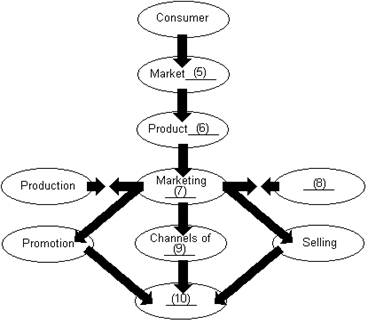
This diagram
shows the marketing process from start to finish. Insert the six missing words
in their correct positions.
Words:
Research, distribution, strategy, consumer, costing, development
5. 8.
6. 9.
7. 10.
XIV.
1. Read
and translate the text.
Definitions of marketing
There are
many different definitions of marketing. Consider some of the following
alternative definitions:
“The all-embracing function
that links the business with customer needs and wants in order to get the right
product to the right place at the right time”
“The achievement of corporate
goals through meeting and exceeding customer needs better than the competition”
“The management process that
identifies, anticipates and supplies customer requirements efficiently and
profitably”
“Marketing may be defined as a
set of human activities directed at facilitating and consummating exchanges”
Which
definition is right? In short, they all are. They all try to embody the essence
of marketing:
• Marketing is about meeting the needs and wants of customers;
• Marketing is a business-wide function – it is not something that operates
alone from other business activities;
• Marketing is about understanding customers and finding ways to provide
products or services which customers demand.
2. Find some more basic definitions
of marketing and the marketing concept.
XV. Time Expressions with Reported Speech
Sometimes when we change direct
speech into reported speech we have to
change time expressions too.
It's Monday. Julie says "I'm leaving today".
If I tell someone on Monday,
I say "Julie said she was
leaving today".
If I tell someone on Tuesday,
I say "Julie said she was
leaving yesterday".
If I tell someone on Wednesday,
I say "Julie said she was
leaving on Monday".
If I tell someone a month later, I say "Julie said she
was leaving that day".
So, there's no easy conversion.
You really have to think
about when the direct speech was said.
Here's a table of some possible
conversions:
|
now |
then / at that time |
|
today |
yesterday / that day / Tuesday / the 27th of June |
|
yesterday |
the day before yesterday / the day before / Wednesday / the 5th of December |
|
last night |
the night before, Thursday night |
|
last week |
the week before / the previous week |
|
tomorrow |
today / the next day / the following
day / Friday |

