ТЕМА 14. ЕТИКА ПРОФЕСІЙНОГО БУХГАЛТЕРА.
1. Етичний кодекс професійних
бухгалтерів: суть і значення.
2. Загальна характеристика фундаментальних
принципів. 5
3. Загрози дотримання професійної етики
бухгалтерами. 5/10
4. Застережні
заходи щодо усунення або зменшення загроз
до прийнятного рівня.
5. Етичні конфлікти у застосуванні
фундаментальних принципів та методи їх розв’язання.
6. Професійна діяльність бухгалтера з точки зору дотримання
філософських принципів прийняття етичних рішень.
1. Етичний кодекс професійних бухгалтерів:
суть і значення.
Міжнародна федерація бухгалтерів запровадила міжнародний Кодекс
етики професійних бухгалтерів як основу для етичних вимог (кодексу етики,
детальних правил, рекомендацій, норм поведінки) до професійних бухгалтерів у
кожній країні, який повною мірою стосується і аудиторів.
Федерація професійних бухгалтерів і аудиторів України (ФПБАУ) рішеннм XІ з’їзду від 24 грудна 2007 року постановила:
Прийняти Кодекс етики Міжнародної федерації бухгалтерів,за
Кодекс етики Федерації професійних бухгалтерів і аудиторів України, який є
обов’язковим для дотримання усіма членами ФПБАУ (https://lexinform.com.ua).
Кодекс етики
професійних бухгалтерів має три складові частини: Частина А – загальне
застосування Кодексу; Частина Б – професійні бухгалтери-практики; Частина В –
професійні бухгалтери в бізнесі.
Частина А встановлює
фундаментальні принципи професійної етики професійних бухгалтерів і надає
концептуальну основу, що її професійні бухгалтери мають застосовувати. Частина Б стосується професійних бухгалтерів-практиків. Частина В стосується професійних бухгалтерів у бізнесі. Професійні бухгалтери-практики
також можуть вважати частину В доречною щодо своїх певних
обставин.
Професійний бухгалтер у бізнесі
може бути штатним працівником, партнером, директором (виконавчим
або не виконавчим),
менеджером-власником, волонтером або
іншою особою, яка працює на
одну чи кілька організацій, що його наймають (ст. 300.3).
2.
Загальна характеристика фундаментальних принципів.
Визначальною характеристикою професії бухгалтера є прийняття на
себе відповідальності діяти в інтересах громадськості. Саме тому професійний
бухгалтер відповідає не лише за задоволення потреб окремого клієнта чи
роботодавця.
Діючи в інтересах громадськості, професійний бухгалтер повинен
дотримуватись етичних вимог, викладених в Кодексі етики професійних бухгалтерів
(КЕПБ).
Професійний бухгалтер повинен дотримуватись таких
фундаментальних принципів (100.5) (рис. 1).
|
Фундаментальні принципи |
||
|
Доброчесність |
Бути щирим та чесним в усіх професійних та ділових стосунках |
|
|
|
|
|
|
Об’єктивність |
|
Не допускати упередженості, конфлікту інтересів або
неправомірного впливу з боку інших осіб на професійні або ділові судження |
|
|
|
|
|
Конфіденційність |
Поважати конфіденційність інформації, отриманої в результаті
професійних та ділових стосунків,і тому не
розголошувати таку інформацію третім сторонам без належного та спеціального
дозволу, якщо немає юридичного чи професійного права розкривати її; не
використовувати цю інформацію для особистої вигоди професійного бухгалтера
або третіх сторін |
|
|
Професійна поведінка |
|
Дотримуватися відповідних законів та нормативних актів та
утримуватись від будь-яких дій, які дискредиють
професію |
|
|
|
|
|
Професійна компетентність та належна
ретельність |
|
Підтримувати професійні знання та навички на рівні, потрібному
для забезпечення отримання клієнтом чи роботодавцем компетентних, професійних
послуг, що базуються на сучасних тенденціях практики, законодавстві та
методиках, а також діяти сумлінно і відповідно до застосовних технічних та
професійних стандартів |
Рис. 1 – Фундаментальні принципи.
3. Загрози дотримання професійної етики бухгалтерами.
Обставини, в яких діють професійні бухгалтери, можуть викликати
специфічні загрози порушення фундаментальних принципів. Неможливо визначити
кожну ситуацію, яка створює такі загрози, та вжити відповідні застережні
заходи.
Концептуальна основа кодексу вимагає від професійного бухгалтера
не простого дотримання конкретних правил, що можуть бути довільними, а
виявлення, здійснення оцінки та усунення загроз у порушенні фундаментальних
принципів.
Загрозу для дотримання фундаментальних принципів можуть
становити різні обставини, які розподіляються за такими категоріями (рис. 2).
Приклади обставин, що можуть створювати загрози для професійного
бухгалтера-практика, наведені в пп. 200.4 (загрози
власного інтересу), 200.5 (загрози власної оцінки), 200.6 (загрози захисту),
200.7 (загрози особистих стосунків), 200.8 (загрози тиску) КЕПБ.
Приклади обставин, що можуть створювати загрози для професійного
бухгалтера в бізнесі, наведені в пп. 300.8 (загрози
власного інтересу), 300.9 (загрози власної оцінки), 300.10 (загрози захисту),
300.11 (загрози особистих стосунків), 300.12 (загрози тиску) КЕПБ.
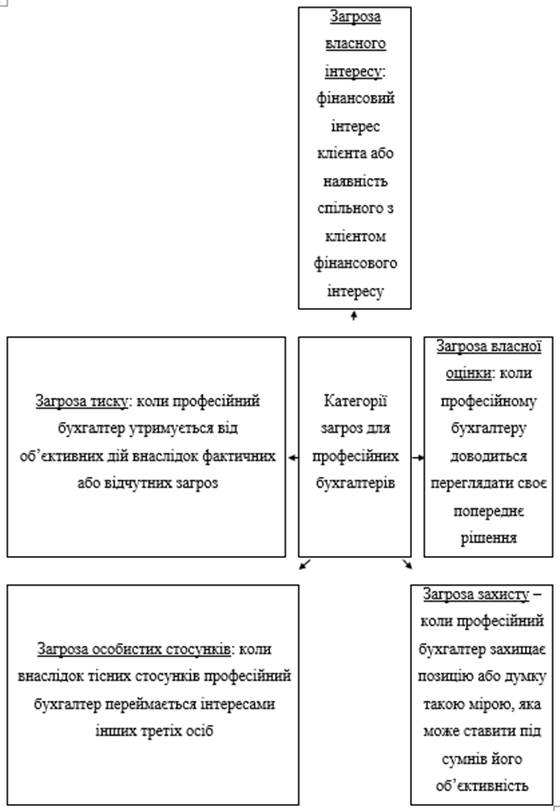
Рис. 2. Категорії загроз для професійних бухгалтерів
4. Застережні заходи щодо усунення або зменшення загроз до
прийнятного рівня.
Застережні заходи, що можуть усунути або зменшити загрози до
прийнятного рівня, належать до двох широких категорій:
1) застережні заходи, встановлені
професійними організаціями, законами чи нормативними актами,
передбачають:
- вимоги до
освіти, професійної підготовки та досвіду для набуття статусу фахівця;
- вимоги подальшої
професійної освіти;
- нормативні акти
щодо корпоративного управління;
- професійні
стандарти;
- моніторинг з
боку професійних організацій або регулювальних органів і дисциплінарні
процедури;
- зовнішній огляд
юридично уповноваженою третьою стороною звітів, податкових декларацій,
листування або інформації, підготовлених професійним бухгалтером (п. 100.14).
2) застережні заходи у робочому
середовищі.
У робочому середовищі відповідні застережні заходи будуть різні залежно від
обставин. До застережних заходів у робочому середовищі належать застережні
заходи на рівні фірми та застережні заходи на рівні завдання.
Приклади застережних заходів для професійного
бухгалтера-практика у робочому середовищі наведені в пп.
200.12 (на рівні фірми), 200.13 (на рівні завдання) Кодексу етики професійних
бухгалтерів. Приклади застережних заходів для професійного бухгалтера в бізнесі
у робочому середовищі наведені в пп. 300.14 Кодексу
етики професійних бухгалтерів.
5. Етичні конфлікти та методи їх розв’язання.
Внаслідок виконання завдання у професійного
бухгалтера, аудитора можуть виникати етичні конфлікти у застосуванні
фундаментальних принципів. Починаючи процес офіційного чи неофіційного
розв’язання конфлікту, професійний бухгалтер, розглядає окремо або разом, такі
складові цього процесу: 1) відповідні факти; 2) пов’язані з процесом етичні
питання; 3) фундаментальні принципи, що стосуються цього питання; 4)
встановлені внутрішні процедури; 5) альтернативні заходи.
Розглянувши ці питання, професійний бухгалтер визначає належні
заходи, що відповідають визначеним фундаментальним принципам. Професійний
бухгалтер також вивчає наслідки кожного з можливих заходів. Якщо питання
лишається невирішеним, бухгалтер звертається до інстанцій в наступній
послідовності:
- консультування з
відповідними представниками фірми чи організації, яка його наймає, для
отримання допомоги в розв’язанні проблеми;
- обговорення з
найвищим управлінським персоналом організації, наприклад, з членами Ради
директорів або комітету з аудиту;
- отримання поради
відповідного професійного органу або радників з правових питань для розв’язання
етичних проблем без порушення конфіденційності.
За неможливості
застосування застережних заходів професійний бухгалтер повинен:
- відхилити або
припинити надання конкретної професійної послуги,
- АБО відмовитись
від клієнта (у випадку професійного бухгалтера-практика)
- АБО звільнитись
з організації-роботодавця (у випадку найманого професійного бухгалтера).
Якщо всі належні можливості вичерпані, а етичний конфлікт
залишається невирішеним, професійний бухгалтер повинен, якщо це можливо,
відмовитись від подальшого вирішення питання, що спричинило конфлікт.
6. Професійна діяльність бухгалтера з точки зору дотримання
філософських принципів прийняття етичних рішень.
Професійна діяльність бухгалтера,
зокрема, передбачає формування різних форм звітності (фінансова, податкова,
статистична, внутрішня або упралвнська) та
відповідальність за правдивість поданої у цій звітності інформації.
Зупинимось більше на
управлінських звітах, які містять як фінансову, так і нефінансову інформацію. З
точки зору дотримання філософських приницпів
прийняття управлінських рішень важливими є такі формати управлінської звітності, які б забезпечували
інформацією менеджмент економічного суб’єкта задля прийняття управлінських
рішень виважено та з високим рівнем відповідальності перед суспільством за
наслідки діяльності певного суб’єкта господарювання.
Так, згідно принципу утилітаризму правильність рішення визначається тим, що воно приносить максимальну користь більшості людей, а не окремим особам (власникам бізнесу, інвесторам і т.д.).
Відповідно до принципу дотримання
прав людини в контексті глобалізаційних процесів та екологічних загроз,
актуальним є такі важливі аспекти, як захист
екології, раціональне використання ресурсів та впровадження екологічних
стандартів. Тому при формуванні управлінських звітів слід акцентувати увагу на
дотриманні екологічних стандартів, моніторингу якості земельних та інших
природних ресурсів, мінімізації негативного впливу на навколишнє середовище
тощо.
TOPIC 14. ETHICS
OF A PROFESSIONAL ACCOUNTANT.
1. Code of ethics for professional
accountants: essence and meaning.
2. General characteristics of the
fundamental principles.
3. Threats to compliance with
professional ethics by accountants.
4. Precautions to eliminate or reduce
threats to an acceptable level.
5. Ethical conflicts in the application
of fundamental principles and methods for their resolution.
6. Professional activities of an
accountant from the point of view of compliance with philosophical principles
of ethical decision-making.
1. Code of ethics for professional accountants: essence and
meaning.
The
International Federation of Accountants has introduced the International Code
of Ethics for Professional Accountants as the basis for ethical requirements
(code of ethics, detailed rules, recommendations, standards of conduct) for
professional accountants in each country, which fully applies to auditors.
The
Federation of Professional Accountants and Auditors of Ukraine (FPBAU) by the
decision of the XI Congress of December 24, 2007 decided: To adopt the Code of
Ethics of the International Federation of Accountants as the Code of Ethics of
the Federation of Professional Accountants and Auditors of Ukraine, which is
mandatory for compliance by all members of the FPBAU.
The
International Code of Ethics for Professional Accountants has four components:
1)
Part 1. Compliance with the requirements of the code, fundamental principles
and conceptual framework – contains fundamental principles and conceptual
framework and applies to all professional accountants;
2)
Part 2. Professional Accountants in Business – contains additional material
that applies to professional accountants in business in the performance of
their professional activities. Professional accountants in business include professional
accountants who are employed, engaged or contracted in managerial or
non-managerial positions in the following sectors: commerce, industry or the
service sector; the
public sector; education; the not-for-profit sector; regulatory bodies or
professional organizations.
Part
2 also applies to individuals who are professional accountants in public
practice in the performance of their professional activities in accordance with
their relationship with a firm, whether as contractors, employees or owners;
3)
Part 3. Professional Accountants in Public Practice – contains additional
material that applies to professional accountants in public practice in the
performance of their professional services;
4)
Part 4. International Standards on Independence, which provides additional
material applicable to professional accountants in public practice when
providing assurance services, namely:
Part
4A. Independence for Audit and
Review Engagements applies to audit or review engagements;
Part
4B. Independence for Assurance
Engagements Other than Audit and Review Engagements applies to assurance
engagements other than audit or review engagements.
2.
General characteristics of the fundamental
principles.
The distinctive feature of the accounting profession
is its acceptance of the responsibility to act in the public interest. In acting in the public interest, a
professional accountant considers not only the interests or requirements of an
individual client or employing organization, but also the interests of other
stakeholders in the performance of professional activities.
In acting in the public interest, a professional
accountant must comply with the ethical requirements set out in the
International Code of Ethics for Professional Accountants (ICPEA).
A professional accountant must comply with each of
the fundamental principles (Figure 14.1).
|
Honesty |
Be open and
truthful in all professional and business relationships |
|
|
|
|
|
|
Objectivity |
|
Avoid bias,
conflict of interest, or undue influence from others on professional or
business judgment |
|
|
|
|
|
Privacy |
Respect the
confidentiality of information obtained as a result of professional and
business relationships and therefore not disclose such information to third
parties without proper and specific authorization, unless there is a legal or
professional right to disclose it; not use this information for the personal
benefit of the professional accountant or third parties |
|
|
Professional behavior |
|
Comply with
relevant laws and regulations and refrain from any actions that bring the
profession into disrepute |
|
|
|
|
|
Professional competence and due diligence |
|
Maintain
professional knowledge and skills at a level necessary to ensure that the
client or employer receives competent, professional services based on current
practice trends, legislation and methodologies, and to act with integrity and
in accordance with applicable technical and professional standards |
Figure 14.1 Fundamental principles
3. Threats to compliance with professional ethics by accountants.
The circumstances in which professional accountants
operate may create specific threats to compliance with the fundamental
principles. It is
not possible to identify every situation that creates such threats and apply
appropriate safeguards.
The conceptual framework of the code requires a
professional accountant not to simply comply with specific rules, which may be
arbitrary, but to identify, evaluate and address threats to compliance with the
fundamental principles.
Threats to compliance with the fundamental
principles may arise from a variety of circumstances, which are categorized as
follows (Figure 14.2).
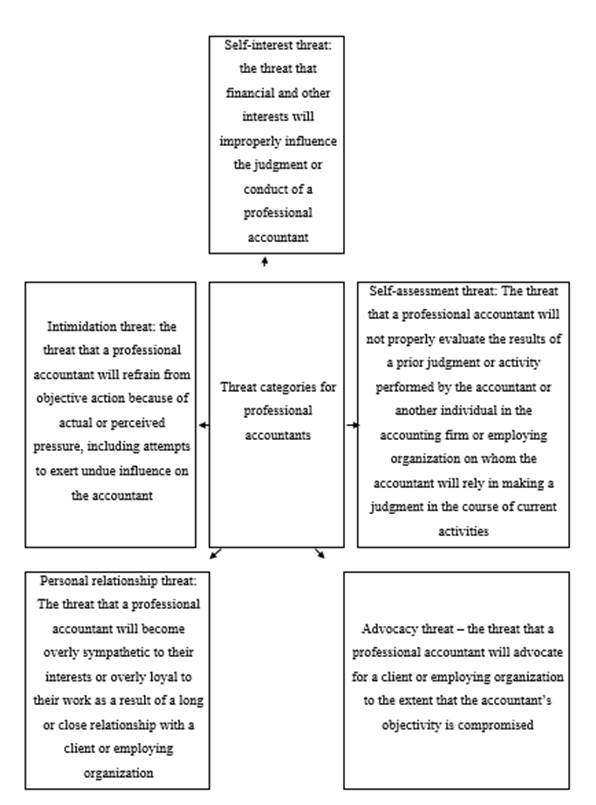
Figure 14.2 Threat categories for
professional accountants
When a professional
accountant identifies a threat to compliance with the fundamental principles,
the professional accountant shall evaluate whether the level of the threat is
acceptable.
An acceptable level
is a level at which it is likely that the professional accountant, using a
reasonable and informed third party review, would conclude that the
professional accountant is complying with the fundamental principles.
4. Precautions to eliminate or reduce threats to an
acceptable level.
If a professional
accountant determines that the level of identified threats to compliance with
the fundamental principles is unacceptable, the accountant shall respond to
those threats by eliminating them or reducing them to an acceptable level. The accountant shall do this by:
a) Eliminating the
circumstances, including interests or relationships, that create the threats;
b) Applying
safeguards, if any, and if applicable, to reduce the threats to an acceptable
level; or
c) Refusing or
terminating the specific professional activity.
Safeguards are
actions taken by a professional accountant that, individually or in the
aggregate, effectively reduce threats to compliance with the fundamental
principles to an acceptable level.
Safeguards that may
eliminate or reduce threats to an acceptable level fall into two broad
categories:
1) Safeguards
established by professional organizations, laws or regulations include: - requirements for education, training
and experience for professional status; - continuing professional education requirements; - corporate governance regulations; - professional standards; - monitoring by professional
organizations or regulators and disciplinary procedures; - external review by a legally
authorized third party of reports, tax returns, correspondence or information
prepared by the professional accountant;
2) Work environment
safeguards. In the work environment, appropriate safeguards will vary depending
on the circumstances.
Work environment
safeguards include firm-level safeguards and engagement-level safeguards.
5. Ethical conflicts in the application of fundamental
principles and methods for their resolution.
As a result of the performance of an
engagement, an accountant in public practice may be confronted with ethical
conflicts in the application of fundamental principles. In initiating a formal or informal resolution process,
the accountant shall consider, separately or in combination, the following
elements: 1) the relevant facts; 2) the ethical issues involved; 3) the fundamental principles relevant to the issue; 4) the established internal procedures; and 5) alternative courses of action.
Having considered these issues, the
accountant shall determine appropriate courses of action consistent with the
identified fundamental principles. The accountant shall also consider the implications of
each course of action. If the issue remains unresolved, the accountant shall
proceed in the following order:
- consult with appropriate
representatives of the firm or organization that employs the accountant for
assistance in resolving the issue;
- discuss with the organization’s most
senior management, such as members of the board of directors or audit
committee;
- Seek advice from an appropriate
professional body or legal advisors to resolve ethical concerns without
compromising confidentiality.
If safeguards are not available, the
professional accountant should:
- Refuse or discontinue the specific
professional service,
- OR Resign from the client (in the
case of a professional accountant in practice)
- OR Resign from the employing
organization (in the case of a professional accountant in employment).
If all appropriate avenues have been
exhausted and the ethical conflict remains unresolved, the professional
accountant should, if possible, decline to further address the matter that gave
rise to the conflict.
6. Professional
activities of an accountant from the point of view of compliance with
philosophical principles of ethical decision-making.
The professional activity of an accountant, in
particular, involves the formation of various forms of reporting (financial,
tax, statistical, internal or management) and responsibility for the
truthfulness of the information presented in this reporting.
Let us dwell more on management reports, which contain
both financial and non-financial information. From the point of view of adhering to the philosophical
principles of making managerial decisions, such formats of management reporting
are important, which would provide the management of an economic entity with
information in order to make managerial decisions in a balanced manner and with
a high level of responsibility to society for the consequences of the
activities of a particular business entity.
Thus, according to the principle of utilitarianism, the
correctness of a decision is determined by the fact that it brings maximum
benefit to the majority of people, and not to individuals (business owners,
investors, etc.).
In accordance with the principle of respecting human
rights in the context of globalization processes and environmental threats,
such important aspects as environmental protection, rational use of resources
and implementation of environmental standards are relevant. Therefore, when forming management reports, attention
should be focused on compliance with environmental standards, monitoring the
quality of land and other natural resources, minimizing negative impact on the
environment, etc.

